Butters has traveled successfully from the mainland to Hawaii (LAX to HNL) a dozen times, and we want to help break down the process for you in case you’re looking to do the same! If you’re planning to fly to Hawaii with your dog, and want them to be released at the airport upon arrival, aka Direct Airport Release, you will need to prepare months in advance. Here’s a breakdown of everything you need to know:
1. Microchipping
First, make sure that your dog is microchipped and that it’s registered. This is how the Hawaii Animal Quarantine Office verifies and identifies your dog matches your completed paperwork. If they cannot identify your dog, they will be subject to quarantine.
2. Hawaii is Rabies Free
The reason that Hawaii is so strict about animals coming in to the state is because they’re the only state that is rabies free and need to keep it that way! To skip the rabies quarantine, make sure you do these steps:
First, your pet must have received at least two rabies vaccinations in its lifetime, given at least 30 days apart. The most recent vaccination must be done more than 30 days before your dog arrives in Hawaii. Be sure to keep certificates for both vaccinations from your veterinarian, as you’ll need to provide these copies as proof to the Hawaii Animal Quarantine Office.
Second, To show your dog is rabies-free, you’ll need a passing FAVN rabies antibody test result from an approved lab, such as Auburn University, Kansas State University, the University of Missouri, or the DOD Food Analysis and Diagnostic Lab in Texas. We requested the FAVN test from our vet, and they sent in the sample for us. Butters’ test was done by Kansas State University, and it took about a month. The test results then get sent to Hawaii Animal Quarantine Office for you. Some vet offices do not assist with travel to Hawaii due to the complex nature, so make sure to ask first if your vet is able to assist. For example, Modern Animal does not offer this service and outsources complex or international pet travel requests to All Paws Express.
- The lab must receive your dog’s blood sample more than 30 days and less than 36 months before your pet arrives in Hawaii. Even with a passing result, if your dog arrives on Oahu before the 30-day waiting period is complete, they won’t qualify for early release and will be placed in quarantine at your expense.
- You may request a copy of the test results for your records directly from your veterinarian, not the lab. I also suggest calling the quarantine office to confirm that they received the test results. This most recent time that we did the FAVN, they thought they didn’t have Butters’ results but discovered that my vet office accidentally mistyped one number of my microchip number! Luckily I checked, and there was enough time to get it corrected and matched up.
3. Prepare and Submit Documentation
To qualify your dog for Hawaii’s Direct Airport Release program, you’ll need to submit several important documents. The full list is available on The Animal Quarantine Information Page in Checklist 1 (unless you’re traveling to a neighbor island like Kauaʻi, Maui, or Hawaiʻi Island—then use the neighbor island checklist). Always check the site to make sure you’re using the most updated checklist and AQS-279 Form.
📋 What You’ll Need:
- Completed Dog & Cat Import Form (AQS-279)
- Two original rabies vaccination certificates, signed in ink by your veterinarian. My vet’s signature was electronic, but it was an original color copy, and the quarantine office accepted it.
- An original health certificate, issued within 14 days of your pet’s arrival in Hawaii. I made an appointment with our vet to do a health check and provide the health certificate for us. Make sure to set an appointment for this in case your vet is busy within that 14 day window prior to your travel. This is the one form that it’s okay not to mail in with everything else, and can be handed to the quarantine office in person upon arrival. You’ll want to make a few copies because the airline may also want to keep one when you check in.
- Proof of tick and tapeworm treatment, provided by your vet. This proof is part of the health certificate. If you usually administer your dog’s tick and tapeworm medication, you may want to time it accordingly since the health certificate requires your vet to indicate that they administered it.
- Payment:
- $185 for Direct Airport Release, or
- $244 for the 5-Day-or-Less Program
- Payable by cashier’s check to the Department of Agriculture
✉️ How to Submit:
- Mail all documents together so they arrive at least 10 days before your arrival. Try not to cut it close, as sometimes mail carriers experience delays. One time, our documents made it to the office exactly 10 days prior to arrival, and when I called the office, they said that I could have risked needing to quarantine.
- Address:
Animal Quarantine Station
99-951 Halawa Valley Street
Aiea, Hawaii, 96701 - Send with a return receipt or use an overnight carrier with tracking
4. Booking Flights
As of this year, I believe the only airline that allows pet in cabin into Hawaii is Hawaiian Airlines. Alaska Airlines used to as well, but they merged with Hawaiian, and it looks like all of the routes from the mainland to Hawaii are now serviced by Hawaiian.
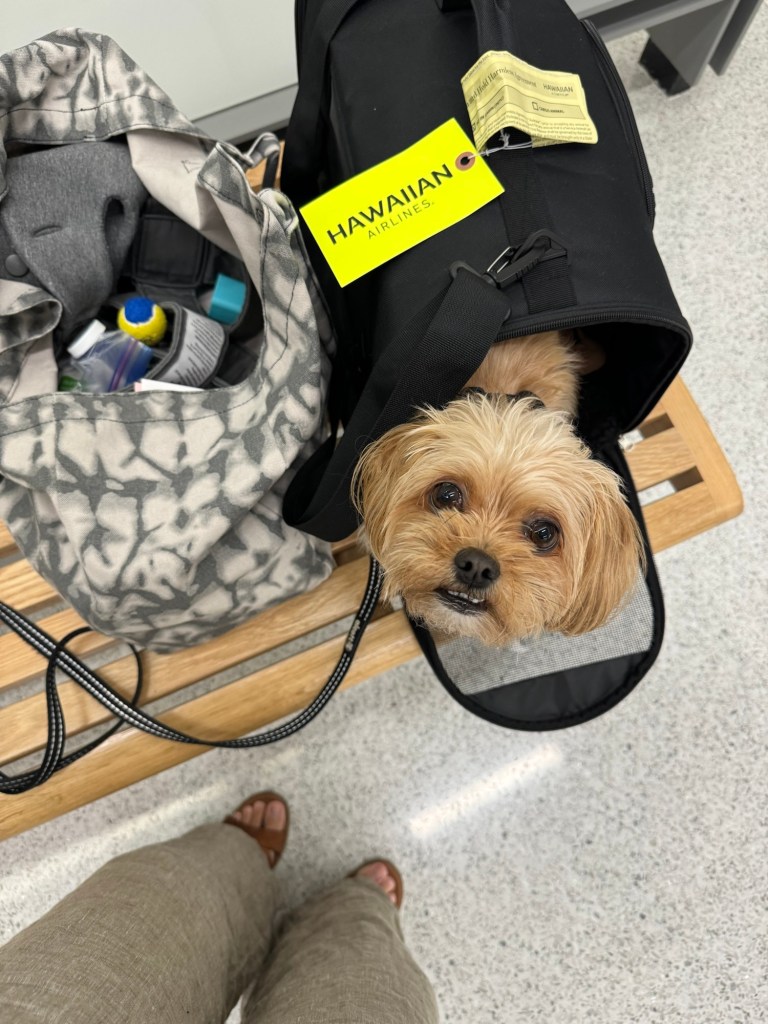
Carrier size: Hawaiian Airlines’ pet carrier size restriction is the most restrictive I’ve seen out of all the airlines I’ve flown domestically. The maximum allowable pet carrier size is 17” long x 11” wide x 9.5” tall, be composed entirely of soft material with TWO OR MORE ventilation panels, be able to close securely and fully encase the animal, and be able to be stowed properly beneath the seat in front of you. Make sure to click on the COMPLETE PET IN CABIN TRAVEL GUIDE to ensure you’re referencing the most up to date info here: https://hawaiianair.custhelp.com/app/answers/detail/a_id/659/~/pets-traveling-in-the-cabin
And yes, they will take out a measuring tape and literally measure the carrier. We almost weren’t allowed onto the flight because our carrier didn’t have the approved number of ventilation panels in 2024 (at that time, they required 4 and ours had 3).
Plan your flights carefully around the operating hours of the Airport Animal Quarantine Holding Facility (AAQHF) at Daniel K. Inouye International Airport (HNL): 8:00 a.m. to 4:30 p.m. (closing early at 3:30 p.m. on weekends and state holidays). Pets arriving after hours won’t be released until the next morning between 8:00–10:00 a.m. If not picked up during that window, they’ll be transferred to the Animal Quarantine Station in Halawa. This has never happened to Butters, but we know of a few friends who have had to do this and had to wait to be reunited!
Pro tip: I always book the earliest flight into HNL! The lines are shorter and you don’t risk having to leave your dog for one night of quarantine just because you were waiting around past 4:30.
If your final destination isn’t Oahu and you’re going to a neighboring island, you’ll need to complete Checklist 2.
5. Direct Airport Release
You’ve arrived in Hawaii, now what? Your airline will have a designated staff worker waiting at the gate for you and if there are other travelers on your flight that traveled with a pet, you may have to wait until you’ve all deplaned. Then the airline staff will escort you to the Animal quarantine office, which is about a 10 minute walk. Most of the time they do not allow your pet to go potty because technically they need to stay in the carrier, but I’ve had a few friendly staff workers allowed us to stop by a grassy area first. The office lobby is quite small, so typically only one person per pet is allowed inside. Make sure to have your health certificate ready, and if this is a re-entry (not your dog’s first time), then you will need your release card from your prior visit to show as proof and pay a reduced re-entry fee. The office worker will take your dog (crated) to check their microchip and examine them behind closed doors. You cannot go in with them. The staff will ask you for your ID and health certificate and if any additional fees need to be taken care of, you are able to pay via credit card. I’ve waited between 15 min to an hour for Butters to be released. Once released, you’re done!!
If you found this guide helpful, please let me know ❤️
 Butters The Pup